
1)Internet
: schistosomiasis
: welcome trust
:genito-urinary parasites
2)Zagazig university, foundation in parasitology
Schistosomiasis life cycle | Wellcome Trust (click this link for animation = must see!!)
ok..jom berkenalan dgn Schistosoma lak:
~~~~Schistosoma is also known as BLOOD FLUKE!~~~~~~~
in affected man, they can causing cercarial dermatitis.
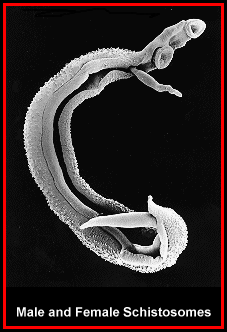
- oral & ventral suckers are little distance apart.
- mouth leads to oesophagus, which divides infront of the ventral suckers,then reunite to form a single caecum.
- adult male is flattened dorso-ventrally but folded on itself to form gynaecophoric canal. its cuticles covered with tubercles.
- testes lie behind ventral sucker.
- adult female is cylindrical. its cuticle is smooth
- ovary is ovoid lies in front of union of the intestinal caeca.
- oviduct proceeds anteriorly, it dilates to join the ootype.
- vitelline gland are on either sides of the single caecum. Vitelline duct opens in ootype.
- uterus proceeds from ootype to open by vagina in the genital atrium.
i) 3 types of species that affecting human:
- Schistosoma haematobium
- Schistosoma japonicum
- Schistosoma mansoni
- by digenetic blood trematodes.
- Schistosoma mansoni = Africa, Middle East, South America & Caribbean
- Schistosoma haematobium = Africa, Middle East
- Schistosoma japonicum = Far East
- S. haematobium = venous plexus of bladder, also in rectal venules.
- S.japonicum = sup. mesenteric Veins (draining the small intestine)
- S.mansoni = inf. mesenteric Veins (draining the large intestine)
Host :
· Definitive host:
§ S.haematobium: man only
§ S. japonicum : Dogs, Cats, Sheeps, pig, goat, cows
§ S. mansoni : monkeys, chimpazees, rodents
· Intermediate Host:
§ Snails i) g. Bullinus = S.haematobium
Ii) g. Biomphlaria =S. mansoni
iii) g. Oncomelania=S. japonicum
eg : genus biomphlaria = S.mansoni
for more picture click here


Infective stage :
§ BIFURCATE CERCARIA swimming in water
· Diagnostic stage:
§ Characteristic EGG in URINE/ STOOL
vi) cell cyle:

vii) pathology and pathogenesis:
Pathological lesions in schistosomiasis result from EGG DEPOSITION IN TISSUES.
Eggs --> Granuloma formation (around tissue affected)--> Delayed hypersensitivity via cell-mediated immune response
1)Granuloma (formed of schistosome)--> cellular aggregation of eosinophils,monocytes,lymphocytes,neutrophils, and plasma cells--> fibroblast appearance--> fibrosis + obstruction of B.V
2)immuno-pathology: due to immune complex deposition in various tissues esp, kidney glomeruli. Immune complex is formed from antigen-antibody combination
- Praziquantel - effective in the treatment of all forms of schistosomiasis, with virtually no side effects
- Oxamniquine - used exclusively to treat intestinal schistosomiasis in Africa and South America
- Metrifonate - effective for the treatment of urinary schistosomiasis
Modern diagnostic techniques are simple, easy to apply and cost very little. Although reinfection may occur after treatment, the risk of serious disease developing in the body organs has been greatly reduced, and it has been observed that there is a marked regression of lesions in young children following treatment of the infection. In the majority of localities where treatment is provided, the total number of cases is reduced within 18 to 24 months. In other localities, according to the local situation, the prevalence has been substantially reduced, and it is encouraging to note that no further intervention is required for intervals between 2 and 5 years.
To be effective, schistosomiasis control strategies should be adapted to the local epidemiological situation and caution must be taken when destroying freshwater snails using chemicals - particularly in terms of impact on the environment.
In 1983, the World Health Organization, in association with the health ministries of several endemic countries (Botswana, Egypt, Madagascar, Mauritius and Zanzibar), launched a massive programme to assess control methods. The findings of this programme are as follows:
- Single dose praziquantel is effective in reducing prevalence and in containing the disease
- Schistosomiasis treatment must be accompanied by health education.
- Praziquantel can be safely administered by primary healthcare teams
- It is almost always necessary to repeat the treatment, but the interval may be up to 5 years in some situations where transmission is low.
- A simple and rapid test for blood in the urine using a paper strip soaked in a reactive agent is more reliable than a microscopic examination, which can prove difficult in the field.
p/s: ok dats all for this week..next tyme kite ckp pasal drugs pulak insyaALLAH..
segala kekurangan harap dimaafkan..
btw: tolong doakan anak buah sy, adik shahrul Hisyam bin Samawi (2 1/2tahun), adik sekarang di NICU disebabkan spleen cancer,dysfuntioning kidney, metastasis-cancer spread up to vital parts.sekarang adik dah last stage (stage 4= life saving 50-50%)..
but i believe in ALLAH miracle..
jika hidup itu baik bagi adik shahrul Hisyam..
doakan sama-sama agar adik dapat sihat seperti sediakala..
tetapi andai kata kematian adalah yang terbaik untuknya..
doakan adik agar mendapat tempat dikalangan org2 yg beriman..
sesungguhnya perancangan ALLAH itu adalah yang terbaik dan terindah..
moga ditabahkan hati kami sekeluarga..
Al-Fatihah sebagai sedekah utk adik Shahrul Hisyam ..
moga2 sedekah ini dpt mengurangkan kesengsaraan yang dialaminya..
"YA ALLAH sungguh kami sayang akan ahli keluarga kami..akan tetapi..jika ENGKAU lebih menyanyanginya..kami redha YA ALLAH.. tabahkanlah hati kami ..kerana kami ini hambamu yang hina..lemah dari segala sudut..tabahkan kami ya ALLAH..tabahkan kami..tabahkan kami..ameen ya Rabb.."
~tears oozing out.. :( ~~minta tlg doakan adik shahrul hisyam kawan2..


